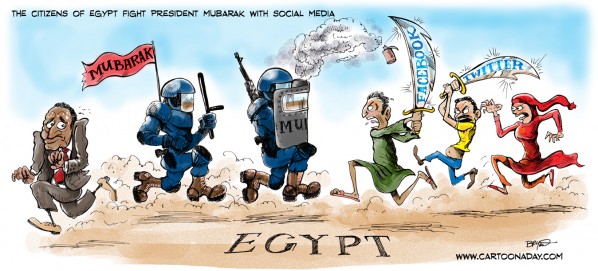
 The citizens of Egypt fight President Mubarak with social media.
Image: Bryant Arnold (Cartoon a day.com)
While some commentators like Phillip Howard deliver glowing reviews of social media's power as an effective revolutionary tool, Evgeny Morozov in this article tries to put things into perspective.
He says the Internet doesn't automatically equal democracy and "cyber utopians" have rose-coloured glasses on to shield themselves from the dormant threat of government regulation.
Morozov's discussion leads to some interesting questions I think we should explore in our feature:
- What is the dynamic and interdependent relationship between social media and on the ground revolution?
- Is the Internet really a new public sphere? Work by John Downey (2007) on 'radical democracy' argues that through its openness, connectedness and global nature, social media provides a newer and more effective platform for facilitating democracy. I will be interviewing Peter Chen who teaches media politics at the University of Sydney about this issue.
- To what degree can regulation and governmental control ultimately usurp citizenry power through their access to vital infrastructure that keeps the web running? I'm particularly referring to the US' 'master switch' idea and when Mubarak 'disconnected' the Internet for a few days during the revolution.
 A graph showing internet traffic to and from Eqypt during the pivotal moments of the revolution.
Image: Arbor Networks (SMH)
Because the revolutions happened in Egypt months ago the 'newness' of feature will come from an in-depth exploration of social media, its use and its place within the democratic framework of governments and its people.
To keep the feature fresh with new news angles, we can also explore how to chart Egypt’s movement from political uprisings to actually forming a democratic government. I will be interviewing Samina Yasmeen from the Centre of Muslim States and Societies at the University of Western Australia for her perspective on this issue.
References
Bryson, Gary (2011) “Islam and the Arab Spring,” ABC Encounter, 12 June 2011 <http://www.abc.net.au/rn/encounter/stories/2011/3238008.htm> [Accessed: 20th August 2011]
Downey, John (2007) "Participant and/or deliberation? The Internet as a tool for achieving radical democratic aims", in Dahlberg and Siapera (eds) Radical Democracy and the Internet: Interrogating Theory and Practice, Palgrave Macmillan: Houndmils.
Howard, Phillip (2010) The Digital Origins of Dictatorship and Democracy, Oxford University Press, Oxford.
Howard, Phillip (2011) “Digital media and the Arab spring,” Reuters, 16 February 2011. <http://blogs.reuters.com/great-debate/2011/02/16/digital-media-and-the-arab-spring/> [Accessed: 20th August 2011]
Morozov, Evgeny (2011) The Net Delusion: The Dark Side of Internet Freedom, Penguin Books, New York.
Morozov, Evgeny (2011) “How much did social media contribute to revolution in the Middle East?” Book Forum, Apr/May 2011 <http://www.bookforum.com/inprint/018_01/7222> [Accessed: 19th August 2011]


